HOME ABOUT CENTROPA OUR TEAM SUPPORTERS & DONATIONS
PRESS INTERNSHIPS NEWSLETTER CENTROPA EVENTS
 
See all Photos
from this family
 
Read the
Biography
 
Family
Tree
 
Send to a
friend
 
Print this
Page
 
Report an
error
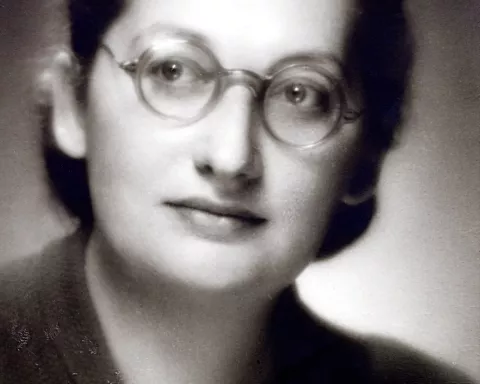
Photo title: Moisei Rabinovich
Photo taken in:Kraslava
Year or decade when the photo was taken: 1930s
Country name today: Latvia
Country name at time of photo: Latvia, 1918-1944
Time of interview: 2002
Interviewee: Vladimir Rabinovich
Interviewer Svetlana Kovalchuk
Key person
Name: Moisei Rabinovich
Born in: 1883 Kreslava, Russia
Died in: 1941 Ezernieki, Latvia


Occupation
before WWII: Pharmacist, mayor

Holocaust related
during holocaust in:
- Military execution,
Died in: Ezernieki
Other person
Name: Moisei Rabinovich


Photo title: Moisei Rabinovich
 
This is my paternal grandfather, Moisei Rabinovich. From 1921 until 1932, he was a member of the Kraslava Municipal Administration. He served as vice-mayor, and later as mayor, and developed the initiative for Kraslava to be granted the status of a city. My grandfather is said to have put forward the idea for a Kraslava city emblem - a boat with five oars, symbolizing the five basic national groups of Kraslava: Jews, Poles, Russians, Latvians and Belorussians.

My family settled in Kraslava by the beginning of 19th century, when Zalman Rabinovich was invited to become the local rabbi by Count Plater. The Platers attracted Jews to the area, both for trade and for crafts. They treated Jews very well and were very loyal.

Zalman Rabinovich had two sons - Abram-Tuvia (Tobias) and Samuil. Both sons followed the progressive Jewish movement known as Haskalah. Both sons were extremely devoted to education, knowledge and the study of secular sciences. They no longer adhered to traditional Jewish religion. Both brothers are my great-grandfathers. Tobias's son, my grandfather Moisei, married his cousin Masha, Samuil's daughter.

My father, Isaak, was an activist. From the beginning of the 1930s he worked in the Bund in Riga. He coordinated a successful strike of retail trade workers in 1933 that forced shop owners to increase workers' wages. Father was punished for his activity. During the revolution in Latvia in 1934, he was jailed for about three months. He was released on condition that he sign a statement obliging him to quit public activity.

At the university, where he studied mathematics, my father became friendly with Vladimir Feigman. My mother, Dora Alperovich, and my father met because they were in Feigman's circle. Feigman took a great interest in photography, and his friends helped him develop snapshots. My mother and father became acquainted in a blacked-out room, printing photos, in the autumn of 1939.

Mother was born in 1912 in a small Belorussian town, Postavy. She studied economics by herself. When she was older, she used to reproach herself saying that she didn't have the persistence to acquire a diploma. By character, she was more of a family woman. Father became a scientific researcher at the astrophysics laboratory of the Academy of Sciences. Father was an outstanding popularizer of mathematical and astronomical knowledge for wide circles of population. He is the author of 186 written works.

When the war began, our family was lucky to evacuate to Russia on June 27, 1941, to the city of Kirov. Mother was pregnant with me then. We were assigned to the village of Uni, far from the railway line.